
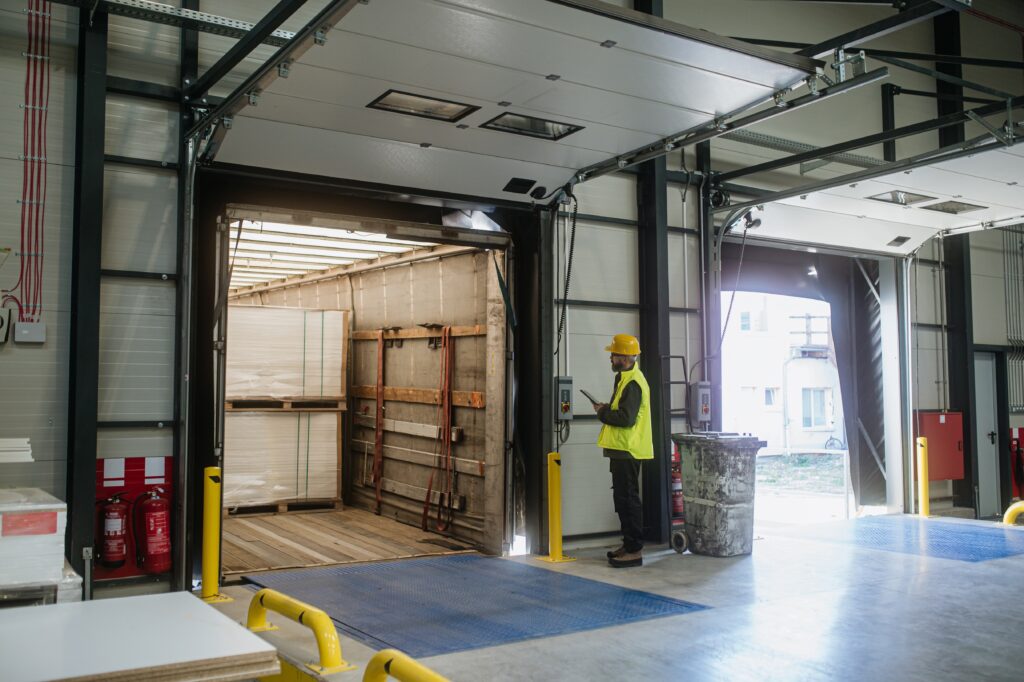
The loading dock is the beating heart of any warehouse or distribution center. It is the critical threshold where goods transition from the chaotic outside world into your organized inventory control system.
When this heart beats rhythmically, your supply chain thrives. However, when it falters, the entire operation suffers from arrhythmia — slowing down shipments, endangering employees, and bleeding revenue.
At Southwest Material Handling Co., we understand that the pressure on logistics professionals is higher than ever. The rise of e-commerce and just-in-time delivery models means that every second counting against your turnaround time is a second you cannot afford to lose.
Many facility managers hesitate to invest in loading dock equipment upgrades, viewing them as disruptive or strictly capital-intensive. But relying on aging infrastructure often costs significantly more in downtime and repairs than the price of modernization.
Let’s examine the critical indicators that suggest it is time to retire your old systems. We will explore the mechanics of dock levelers, the importance of hiring the right loading dock equipment installers, and how a strategic loading dock equipment installation can transform your facility’s throughput.
Signs Your Loading Dock Needs an Upgrade
Determining the exact moment to overhaul your facility requires a keen eye for detail and an understanding of how mechanical wear affects operational flow. It is rarely a single catastrophic failure that signals the end; rather, it is a series of inefficiencies that accumulate over time. If you notice any of the following signs, it is time to consider serious loading dock equipment upgrades.
Outdated Equipment | The Hidden Bottleneck
There is a distinct difference between equipment that is “old” and equipment that is “outdated.” You might have a mechanical leveler that still functions, but if it was designed for the lighter loads of the 1990s and you are now handling heavy automation equipment or high-capacity electric forklifts, that equipment is obsolete.
Outdated loading dock equipment often lacks the ergonomic features and fail-safes present in modern designs. For example, older mechanical dock levelers rely on pull chains and physical strength to operate. This not only slows down the docking process but also increases the physical strain on your workforce. If your team is struggling to manually operate levers or if the transition from the truck to the warehouse floor feels jarring, your equipment is no longer serving your business goals. Modern hydraulic loading dock levelers offer push-button simplicity, smoothing out the transition and drastically reducing cycle times.
Safety Risks | Protecting Your People
Safety is the non-negotiable metric in our industry. The loading dock is statistically one of the most dangerous areas in any facility. As loading dock equipment ages, safety mechanisms can fail or become less reliable.
One major red flag is “dock shock.” This occurs when forklifts drive over dock levelers that have loose suspensions or structural warping, causing a jarring vibration that travels up the driver’s spine. Over time, this leads to chronic injury and increased workers’ compensation claims. Furthermore, outdated restraints may not effectively grip modern trailer rear-impact guards (RIGs), leading to “trailer creep” — where the truck slowly moves away from the dock due to the momentum of the forklift entering and exiting.
If you are seeing near-misses, or if your current vehicle restraints cannot accommodate the varying styles of trailers arriving at your bay, you need to prioritize loading dock equipment upgrades immediately. Newer systems use rotating hooks and advanced communication lights to lock trailers securely in place, guaranteeing that the driver does not pull away while a forklift is still inside.
Increased Maintenance | The Cost of Sticking with the Old
We often hear managers say, “If it ain’t broke, don’t fix it.” But what if you are fixing it every month? There comes a tipping point where the cumulative cost of service calls, parts, and downtime exceeds the monthly financing cost of a new loading dock equipment installation.
Analyze your maintenance logs for the past two years. If you see a recurring pattern of spring failures on your loading dock levelers, hydraulic leaks, or welded repairs on the dock face, you are throwing good money after bad. Aging metal fatigues; once structural cracks begin to appear in the deck or lip of your levelers, spot welding is only a temporary bandage. Partnering with professional loading dock equipment installers to replace these units resets the clock on your maintenance budget, allowing you to allocate those funds toward growth rather than repair.
Larger Volumes and Changing Loads
Your business has likely evolved since you first moved into your facility. Perhaps you have expanded your SKU count, or maybe you have switched from pallet jacks to heavy-duty sit-down forklifts. If your operational volume has increased, your loading dock equipment must scale with it.
We frequently see facilities where the dock levelers are too short or too narrow for the current volume of traffic. A leveler that is too short creates a steep grade for forklifts entering trailers. This steep grade causes “beaching” (where the forklift gets stuck) or causes the load to destabilize and fall. If your receiving team is processing 20% more trucks than they were five years ago, but doing it with the same mechanical pit levelers, you are artificially capping your throughput. Upgrading to air-powered or hydraulic loading dock levelers allows for smoother operation under higher frequency cycles, matching the tempo of a high-volume logistics hub.
The Vital Role of Loading Dock Levelers
To truly understand the value of an upgrade, we must look closer at the specific components. Loading dock levelers are the bridges that connect your stationary warehouse to the mobile fleet of the world. They accommodate the height difference between the dock floor and the trailer bed.
Standard mechanical dock levelers use a spring mechanism. While reliable, they require regular adjustments and are prone to “stump-out” (where the leveler cannot go low enough for a low trailer). Conversely, modern loading dock equipment upgrades often involve switching to hydraulic levelers. These systems are powered by a motor and pump, offering full control over the deck and lip movement.
Why does this matter? Because versatility is key. You might receive a standard 53-foot trailer in the morning and a lower delivery van in the afternoon. Advanced loading dock levelers can interface with a wider variety of truck heights, preventing the logistical headache of turning away a delivery because your equipment physically cannot bridge the gap.
The Importance of Professional Loading Dock Equipment Installers
Buying the best equipment is only half the battle; the execution of the installation is equally critical. We cannot stress enough the importance of utilizing certified loading dock equipment installers.
The installation process involves heavy construction, electrical integration, and precise concrete work. An improper loading dock equipment installation can lead to early equipment failure and voided warranties. For instance, if the pit is not squared correctly or if the shimming is uneven, the leveler will twist during operation. This torque eventually snaps welds and ruins the hydraulic cylinders.
Expert loading dock equipment installers understand the nuances of the “pit.” They know how to handle the removal of the old unit — often a complex task, involving rusted steel and deteriorated concrete — and how to prep the surface for the new unit. They handle the electrical interlocks that allow the leveler to communicate with the door and the vehicle restraint. When you work with SWMHC, you are securing a team that treats the installation with the same level of importance as the equipment selection itself.
Benefits of Upgrading Your Loading Dock
When you commit to loading dock equipment upgrades, you are not just buying metal; you are investing in operational excellence. The return on investment (ROI) manifests in several distinct areas.
Efficiency and Throughput
Time is the currency of the supply chain. Modern loading dock equipment operates faster and more intuitively. Hydraulic dock levelers can be deployed in seconds with the push of a button, compared to the manual effort of pulling chains and walking down the deck. If you save two minutes per truck, and you process 30 trucks a day, that is an hour of labor gained every single day. Over a year, that efficiency gain is massive.
Improved Energy Efficiency
One often-overlooked benefit of a loading dock equipment installation is the seal. Old docks often have gaps around the levelers and worn-out perimeter seals. In the Texas heat, this is equivalent to leaving a window open while the air conditioning runs. Modern loading dock equipment includes brush weather seals and insulated decks that seal the pit tight. By closing these thermal gaps, you reduce the strain on your HVAC system and lower your utility bills.
Employee Morale and Retention
Your workforce knows when you are investing in them. forcing them to struggle with rusted, heavy, or glitchy dock levelers sends a message that their comfort and safety are low priorities. By bringing in professional loading dock equipment installers to revamp their workspace, you reduce their physical burden. A safer, easier-to-use dock leads to happier operators, and in a tight labor market, retention is a competitive advantage.
Reduced Product Damage
Jarring transitions and steep grades damage products. If a forklift bounces violently entering a trailer, the pallet load can shift or topple. Upgraded loading dock levelers provide a smooth transition path, known as “smooth transition doctrine” in the industry, which protects your inventory from impact damage.
Planning Your Loading Dock Equipment Installation
A successful upgrade requires a roadmap. We recommend starting with a site survey. This is where we come in to measure your existing pits, evaluate the slope of your drive approach, and analyze the types of vehicles you service.
Once the survey is complete, we select the right loading dock equipment. This might mean a vertical storing dock leveler for strict temperature control applications, or a heavy-capacity hydraulic leveler for paper roll handling.
The next phase is the schedule. We coordinate the loading dock equipment installers to work during your downtime or in phases so that your operation never comes to a full halt. We handle the logistics of delivery, the disposal of old units, and the commissioning of the new systems.
Finally, we prioritize training. The best loading dock equipment upgrades are useless if the staff doesn’t know how to use them. We train your team on the new controls, safety protocols, and daily inspection requirements.
Invest In Loading Dock Equipment With SWMHC
Your loading dock is the gateway to your business success. Ignoring the signs of wear and tear — outdated mechanics, safety hazards, and rising repair costs — will eventually lead to a critical failure that halts your supply chain. You need a partner who understands the local industry and has the technical expertise to deliver a seamless solution.
At Southwest Material Handling Co., we have been serving the material handling needs of businesses for decades. We supply top-tier loading dock equipment, from robust dock levelers to advanced vehicle restraints and shelters. Our team of expert loading dock equipment installers guarantees that every project is executed with precision and safety.
Don’t wait for a breakdown to force your hand. Be proactive. Let us help you assess your current infrastructure and design a modernization plan that fits your budget and your operational goals.
Ready to transform your loading dock efficiency? Contact Southwest Material Handling Co. today to schedule your site assessment.
FAQ
Q. How do I know if I need a hydraulic or mechanical dock leveler?
The choice depends on your volume and budget. Mechanical dock levelers are cost-effective for low-volume docks but require more physical effort and maintenance. Hydraulic loading dock levelers are ideal for high-volume facilities, offering push-button ease, lower maintenance costs over time, and smoother transitions for forklifts.
Q. How long does a typical loading dock equipment installation take?
For a standard replacement of a single unit, professional loading dock equipment installers can often complete the job in one day. However, if concrete work or electrical upgrades are required, the timeline may extend. We always strive to minimize disruption to your daily operations.
Q. Can I upgrade my loading dock equipment to handle heavier loads without changing the concrete pit?
In many cases, yes. We can often source high-capacity loading dock equipment upgrades designed to fit into existing standard pits. However, a site survey is necessary to verify the condition of the surrounding concrete and guarantee it can support the increased load ratings.
Q. What are the safety benefits of upgrading loading dock equipment?
Newer loading dock equipment features advanced safety technologies such as automatic vehicle restraints to prevent trailer creep, communication light systems for drivers and forklift operators, and safety fuses on hydraulic cylinders to prevent free-fall. These features significantly reduce the risk of accidents.
Q. Do you offer service for the equipment after installation?
Yes. At SWMHC, we support our partners long after the sale. We offer planned maintenance programs for all loading dock equipment to keep your systems running smoothly and to extend the lifespan of your investment.