
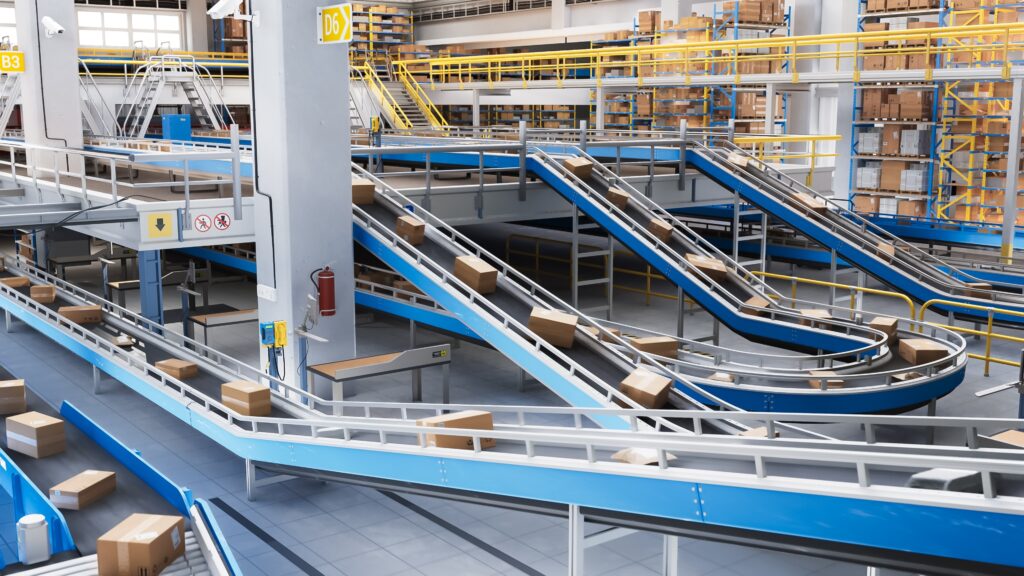
In logistics and manufacturing, efficiency isn’t just a goal: it’s the currency of survival. As supply chains become more complex and customer expectations for rapid delivery tighten, the internal flow of your facility must be seamless. At Southwest Materials Handling Company, we understand that the backbone of this flow is often the technology that moves product from point A to point B. We are talking about Warehouse Conveyor Systems.
Gone are the days when manual transport was the only option for moving goods through a facility. Today, a well-designed Warehouse Conveyor System is the difference between a bottleneck and a breakthrough. Whether you are managing a distribution center in Dallas or a manufacturing plant with national reach, understanding the nuances of these systems is critical. They reduce labor costs, minimize product damage, and drastically increase throughput.
However, not all conveyors are created equal. The market offers a vast array of options, from the ubiquitous Conveyor Belt to complex pneumatic tubes, each designed for specific applications.
Let’s explore the various types of conveyor technologies available today. We will analyze their mechanics, their best-use cases, and how integrating Automated Warehouse Conveyor Systems can revolutionize your operations. Let us explore the machinery that keeps the modern world moving.
Why Conveyor Systems Are Essential for Modern Operations
Before we dissect the specific types, it is vital to understand the aggregate value these systems bring to a facility. A Conveyor System in Warehouse environments serves as the arteries of the operation. By automating transport, you remove the reliance on manual forklift travel for repetitive paths, which significantly improves safety scores.
Furthermore, consistency is key. A Conveyor Belt System runs at a set speed, allowing for predictable throughput calculations. This predictability is essential for inventory control and meeting shipping deadlines. When you upgrade to Automated Warehouse Conveyor Systems, you also gain data. Sensors and scanners track items in real-time, feeding crucial information back to your Warehouse Management System (WMS).
Belt Conveyors | The Versatile Industry Standard
When most people think of material handling, they picture a Conveyor Belt. This is the most common and versatile type of conveyor system in existence. It consists of a wide belt—made of materials ranging from rubber to polymer—looped over two or more pulleys. One or both pulleys are powered, moving the belt and the material on it forward.
The beauty of a Conveyor Belt System lies in its simplicity and adaptability. Because the product rests on a continuous surface, belt conveyors are excellent for moving items that might fall through rollers, such as small parts, bagged goods, or irregular shapes. They are also the go-to solution for changes in elevation. If you need to move product from a receiving dock to a mezzanine, an incline belt conveyor is often the most efficient method.
In terms of Warehouse Conveyor Systems, belt conveyors are often the primary trunk lines. They are relatively quiet, gentle on the products, and can be customized with various belt textures to prevent slippage. Whether you are moving raw materials in a factory or packaging in an e-commerce fulfillment center, the Conveyor Belt remains a foundational tool.
Roller Conveyors | Gravity and Power Combined
Roller conveyors are another staple in the logistics sector. As the name suggests, these systems utilize a series of parallel rollers mounted in a frame to convey goods. They fall into two main categories: gravity roller conveyors and powered roller conveyors.
Gravity roller conveyors are unpowered and rely on—you guessed it—gravity or manual force to move products. These are often seen at the end of sorting lines or in truck loading zones. They are cost-effective and easy to install. However, for a high-throughput Warehouse Conveyor System, powered roller conveyors are often necessary. These use motors to rotate the rollers, propelling the items forward at a controlled speed.
A significant advantage of a roller Conveyor System in Warehouse applications is the ability to accumulate pressure. “Zero Pressure Accumulation” rollers allow packages to queue up on the line without crashing into each other, which is vital for sorting and palletizing zones. However, unlike a Conveyor Belt System, roller conveyors are best suited for items with flat, rigid bottoms, such as cardboard boxes, totes, or pallets.
Overhead Conveyors | Maximizing Vertical Space
Space is a premium commodity in any facility. When the floor is crowded with forklifts, workstations, and inventory, the only way to go is up. This is where overhead Automated Warehouse Conveyor Systems shine. These systems consist of a track mounted from the ceiling, with carriers, hooks, or trolleys that hold the load.
We often see overhead conveyors in manufacturing settings, particularly in painting or finishing lines, where parts need to be suspended for 360-degree access. However, they are increasingly popular in distribution centers for garment handling (garment-on-hanger systems) or for transporting empty cartons away from picking areas to trash compactors.
Implementing an overhead Warehouse Conveyor System allows you to utilize the “air rights” of your building. By keeping the floor clear, you improve traffic flow for personnel and other warehouse equipment. It is a strategic way to increase capacity without expanding your facility’s footprint.
Chain Conveyors | Moving the Heavy Weights
When you are dealing with heavy loads that would tear a standard Conveyor Belt or crush standard rollers, chain conveyors are the solution. These systems use continuous chains to move fixtures or pallets. The load usually rests directly on two or more strands of chain.
Chain conveyors are the heavy lifters of the Warehouse Conveyor Systems family. They are ubiquitous in automotive manufacturing and pallet handling operations. If your facility moves large industrial parts, engine blocks, or fully loaded pallets that are not suitable for rollers, a chain Conveyor System in Warehouse operations provides the durability you need.
Because they operate at low speeds with high torque, they are incredibly reliable for heavy-duty applications. They are less about speed and more about power and stability. While they lack the versatility of a Conveyor Belt System for small items, they are indispensable for heavy material handling.
Screw Conveyors | Handling Bulk Materials
Not all Warehouse Conveyor Systems handle discrete items like boxes or pallets. Some industries need to move bulk materials — grains, powders, wood chips, or aggregates. This is the domain of the screw conveyor.
A screw conveyor consists of a helical screw element (an auger) rotating within a tube or trough. As the screw turns, it pushes the material forward, much like a screw driving into wood. These systems are enclosed, which makes them perfect for handling dusty or hazardous materials that need to be contained.
While you might not see a screw conveyor in a standard Amazon fulfillment center, they are critical Automated Warehouse Conveyor Systems for food processing, chemical manufacturing, and agriculture. They provide a continuous, metered flow of material, which can be crucial for mixing and batching processes.
Pneumatic Conveyors | Air-Driven Efficiency
Pneumatic conveyors represent a completely different approach to material handling. Instead of belts, chains, or rollers, these systems use air pressure (either suction or blowing) to move materials through enclosed tubes.
You might be familiar with the small-scale version of this at a bank drive-thru, but industrial pneumatic Automated Warehouse Conveyor Systems are capable of moving vast quantities of powders, granules, and small parts. They are highly flexible; the tubes can be routed around obstacles, through walls, and between floors with ease, unlike the rigid straight lines required by a Conveyor Belt System.
A pneumatic Conveyor System in Warehouse settings is ideal for protecting the product from contamination and protecting the environment from dust. This makes them a top choice for pharmaceutical and food industries where hygiene is paramount.
Strategic Integration of Conveyor Technologies
The true power of modern material handling lies not in using a single type of conveyor, but in integrating multiple types into a cohesive Warehouse Conveyor System. A typical fulfillment center might use a Conveyor Belt for unloading trucks, a roller system for accumulation, an overhead system for trash removal, and a pneumatic system for packing materials.
This integration is where Automated Warehouse Conveyor Systems truly revolutionize operations. By utilizing sensors, diverters, and software, these distinct systems communicate. A scanner reads a barcode on a box on the Conveyor Belt, determines it needs to go to the shipping dock, and triggers a diverter to push it onto a roller lane. This level of automation reduces human error and drastically speeds up processing times.
When designing a Conveyor System in Warehouse layouts, we must consider the flow of goods. Where are the bottlenecks? Where does the product type change? For example, moving from a rigid pallet (Chain Conveyor) to individual boxes (Belt or Roller Conveyor) requires a specific transfer mechanism. A well-planned Conveyor Belt System integration ensures that there are no “dead zones” in your facility.
Furthermore, safety is a major factor. Warehouse Conveyor Systems reduce the need for manual lifting and carrying, lowering the risk of musculoskeletal injuries. They also segregate pedestrian traffic from heavy product flow. However, these systems must be maintained. A broken Conveyor Belt or a jammed roller can halt the entire operation, which is why choosing high-quality warehouse equipment and a reliable service partner is non-negotiable.
Find The Right Conveyor System Near You
Selecting the right conveyor technology is not a “one-size-fits-all” process. It requires a deep analysis of your SKU profile, your throughput requirements, your facility layout, and your budget. You need a Warehouse Conveyor System that solves your specific problems, not just a generic catalog item.
This is where Southwest Materials Handling Company steps in. We do not just sell equipment; we provide solutions. Whether you need a simple Conveyor Belt System to move parts between workstations or a fully integrated, complex set of Automated Warehouse Conveyor Systems, our team has the expertise to guide you. We analyze your operation to determine where a Conveyor System in Warehouse flows can unlock hidden efficiency.
We understand the unique challenges of the Dallas market and beyond. From heavy-duty chain conveyors for manufacturing to high-speed Warehouse Conveyor Systems for distribution, we partner with you to ensure your investment drives real ROI.
Don’t let inefficient material handling slow down your growth. Contact Southwest Materials Handling Company today for a consultation, and let us design the perfect conveyor solution to keep your business moving forward.
Frequently Asked Questions
Q. How do I determine which Warehouse Conveyor System is best for my facility?
The choice depends heavily on the product you are moving (weight, shape, size), the environment (temperature, dust), and the required throughput speed. A Conveyor Belt is great for irregular items, while rollers are better for rigid boxes. We recommend a site audit to assess your specific needs before investing in Warehouse Conveyor Systems.
Q. What is the maintenance requirement for a standard Conveyor Belt System?
Routine maintenance is essential for longevity. This includes checking the tension and tracking of the Conveyor Belt, lubricating bearings on rollers, and inspecting motors and gearboxes. A well-maintained Conveyor Belt System can last for many years, whereas neglect can lead to costly downtime and belt replacements.
Q. Can I retrofit my existing facility with Automated Warehouse Conveyor Systems?
Yes, absolutely. Automated Warehouse Conveyor Systems are designed to be modular. You can often integrate automation into existing layouts, replacing manual sorting sections with automated diverters or adding sensors to existing lines. This allows you to upgrade your Warehouse Conveyor System incrementally as your budget and needs grow.
Q. Are pneumatic systems considered a type of Conveyor System in Warehouse settings?
Yes, pneumatic conveying is a specialized form of a Conveyor System in Warehouse applications. While they don’t use a Conveyor Belt, they are essential for moving bulk materials like powders or granules efficiently and hygienically, often feeding into packaging lines where standard conveyors take over.
Q. What safety features should be included in a Warehouse Conveyor System?
Safety is paramount. All Warehouse Conveyor Systems should include emergency stop buttons (E-stops) at accessible intervals, side guards to prevent items from falling, and pinch-point guards to protect workers. When installing a Conveyor Belt System, we also recommend proper signage and training for all floor staff.